
Kosciusko County Arrest Records and Charges
Kosciusko County arrest records are not the same as a court charge record. The arrest or booking side can show that law enforcement took a person into custody and may include custody status, booking details, a charge label, bond, or a link to the current jail route. The court charge record begins when the State of Indiana, through the prosecutor, files formal charges in the local trial court. That filing creates a case path that can be searched through court records.
The official Kosciusko County Prosecutor page says the office prosecutes individuals charged with crimes and other violations of state statutes occurring in the county. The Sheriff and local police may make or refer arrests, but the prosecutor decides what formal charges to pursue. For the full case file, outcome, and sentence, use the Kosciusko County criminal court records page.
The Warsaw Police Department page reflects the local law-enforcement side of Kosciusko County arrest records.
Police records may relate to the arrest event, while the court charge record is created through the prosecutor and trial court filing process.
Kosciusko Arrest to Charge Path
After an arrest in Kosciusko County, several records can exist at the same time. A jail or custody record may show the person is held or recently booked. A law-enforcement report may remain with the arresting agency and may be limited while an investigation is open. A court charge record is narrower than the full criminal file, but broader than a jail booking line because it identifies what offenses were actually filed with the court.
Record path: Arrest or referral › prosecutor review › charging document filed › court case opened › charge status changes › disposition or dismissal
| Record | Primary Source | What It Can Show |
|---|---|---|
| Arrest or booking record | Sheriff, jail, or police agency | Custody, booking, suspected offense label, bond, and release status when available. |
| Court charge record | Prosecutor and Clerk | Filed counts, statute, class, filing date, bond, plea, amendments, and disposition. |
| Full criminal case file | Clerk of the Circuit and Superior Courts | Charges plus hearings, motions, orders, sentence, payments, and later court activity. |
Note: A person may be arrested without every suspected offense becoming a filed court charge.
Find Kosciusko County Arrest Records
Use the county jail route first for very recent custody or booking questions, then use MyCase for court charges after arrest. The official Sheriff inmate information page links to a current inmate list through Kosciusko County Inmate Info, while the Indiana public-records hub links to the Indiana County Jail Public Portal for county jail offender searches. The court side is searched through Indiana MyCase once a charge has been filed in the Circuit and Superior Courts.
- For current custody, check the official Sheriff inmate information route or call the AIS Direct Access inmate line at 866-322-5857.
- For charges after arrest, search MyCase by defendant name or case number and confirm the court is in Kosciusko County.
- Open the case summary and read the charge list, statute, severity level, filing date, and any amended or dismissed entries.
- Use the Clerk record-copy form or online public-records request when a document image or certified copy is needed.
- Call the Clerk at 574-372-2331 or the court division when the case number or court assignment is unclear.
The Indiana County Jail Public Portal is one official custody-related route for county jail searches.
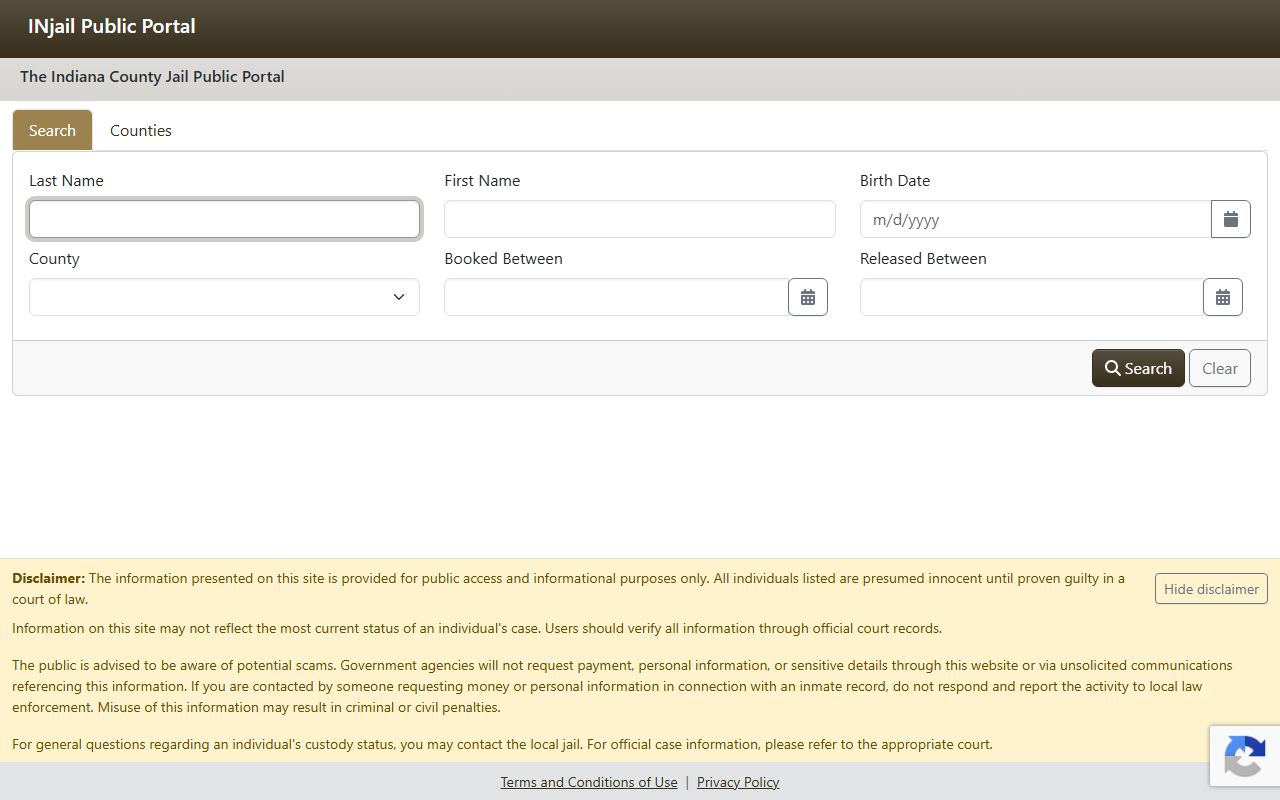
That portal is useful for custody checks, but court charges and outcomes should be verified against MyCase or Clerk records.
Kosciusko Charging Documents
Charges after arrest are filed through a charging document. Indiana county practice commonly uses prosecutor-filed charging information, and the research describes a charge record as showing the offenses filed in court after law enforcement referred or arrested a person. A charge record may identify the State of Indiana as plaintiff, defendant, statute or case class, count number, filing date, prosecutor, bond, plea, and disposition.
| Document Type | Who Uses It | What It Starts or Supports |
|---|---|---|
| Complaint | Law enforcement or prosecutor, depending on case path | States allegations and can support the start of a criminal case or probable cause review. |
| Information | Prosecutor | Formal prosecutor-filed charges used in many Indiana criminal cases. |
| Indictment | Grand jury process | Formal charge returned through grand jury action, less common than prosecutor information in many local cases. |
The charging document is not the final word on guilt. It is the formal accusation that lets the case move to an initial hearing, plea, motions, trial setting, dismissal, or sentencing.
Kosciusko Charge Status Terms
Charge status can change throughout a Kosciusko County criminal case. One count may remain pending while another is dismissed. A prosecutor may amend a count, reduce a charge, or dismiss one count as part of a plea agreement. The CCS and charge-level entries should be read together because the docket timeline explains why a charge changed.
| Status | Meaning in a Court Charge Record |
|---|---|
| Pending | The charge has been filed and has not reached a final charge-level outcome. |
| Amended | The filed charge was changed, often to correct, add, or revise the offense level or statute. |
| Reduced | The charge was lowered to a different offense or severity level, often through plea negotiations. |
| Dismissed | The charge ended without a conviction on that count. |
| Disposed | The charge has a recorded outcome, such as guilty, not guilty, dismissal, or other final action. |
What Kosciusko Charge Records Show
A court charge record after arrest is a focused slice of the larger criminal case. It centers on the counts filed in court and the status of those counts. The same case may also contain motions, orders, hearing notices, sentencing details, financial entries, and probation terms, but the charge view should be read first to understand what the defendant was accused of and what happened to each count.
| Field | What It Shows |
|---|---|
| State of Indiana | The plaintiff in a criminal prosecution. |
| Defendant | The person charged in the court case. |
| Count number | The separate charge within a case that may have its own status. |
| Statute or code | The Indiana law or offense label tied to the filed charge. |
| Case class or level | Felony, misdemeanor, infraction, or related severity category where shown. |
| Filing date | When the court charge was filed. |
| Bond | Release amount or condition when entered in the case. |
| Plea and disposition | How the charge was answered and how it ended. |
Charge vs Conviction
A charge is not a conviction. The distinction is critical in Kosciusko County arrest records because a recent arrest may be followed by charges that are later changed or dismissed. Court records may show both the original charge and the final charge outcome, so the disposition column or CCS entry must be checked before drawing a conclusion.
| Point | Charge | Conviction |
|---|---|---|
| Role | An accusation filed by the State of Indiana. | A final guilty finding or plea. |
| Proof | Based on prosecutor filing and probable cause path. | Based on plea, verdict, or court disposition. |
| Record read | Check status for pending, amended, reduced, or dismissed. | Check sentence, probation, fines, costs, and restitution. |
| Common mistake | Treating an accusation as final. | Ignoring dismissed counts in the same case. |
Kosciusko Prosecutor Charge Review
Indiana's county prosecutor is the local equivalent of a district attorney for criminal-charge filing. Research identifies J. Brad Voelz as the Kosciusko County Prosecuting Attorney, and the official state profile says he was elected in November 2022 after previously serving as chief deputy. The Prosecutor's Office address is 121 N Lake St, Warsaw, IN 46580, and the phone number is 574-372-2419.
The Prosecutor also maintains a Pre-Trial Diversion Program. The program is discretionary and can be offered to defendants without significant prior criminal records who face certain qualifying charges. The defendant must attend the initial court date, receive advisement of rights, follow the plea path, and apply before the pre-trial conference. Successful completion can result in dismissal of charges; failure can return the case to ordinary prosecution.
The Kosciusko Prosecutor Pre-Trial Diversion Program page connects charge records to a local dismissal path.
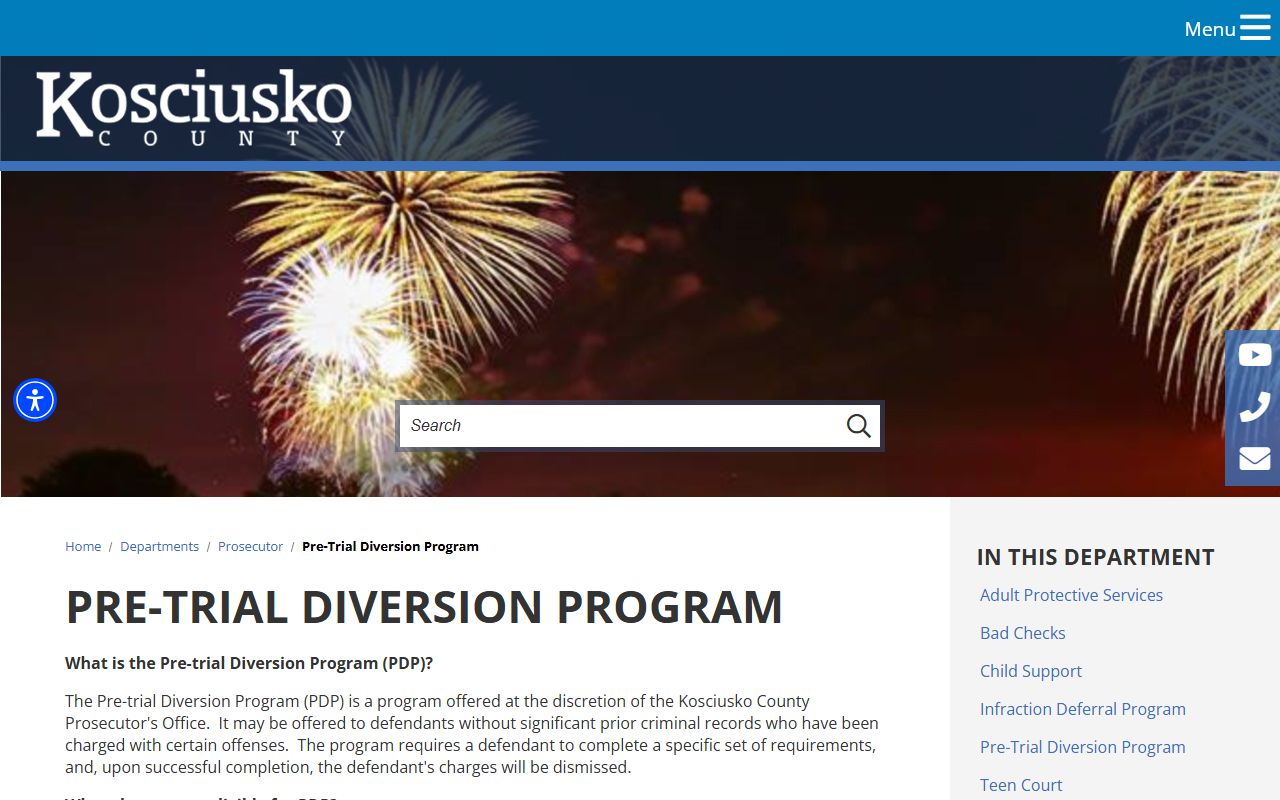
Diversion is one reason a filed charge and a final conviction may differ in a Kosciusko County court record.
Public Access to Charge Records
Indiana public access rules apply to charge records after arrest. MyCase is the starting point for public trial-court case data, while the Clerk provides certified copies and records not available online. The Clerk's public-records page lists copy fees of $1.00 per page, $3.00 for certification, $1.00 for a CCS, and $1.00 for a support payment history. Email requests are not processed until payment is made, and personal checks are not accepted.
Access rule: Indiana Administrative Rule 9 governs public court-record access, while IC 35-38-9 controls qualifying sealing and expungement of arrest, charge, and conviction records.
Juvenile charges, sealed records, expunged matters, protected addresses, victim-safety details, and law-enforcement investigatory records may be limited. The Sheriff's app exists on Google Play and the Apple App Store and supports public safety news, information, and tip submission, with inmate search reported at launch. No app-only charge or warrant database was verified in official source material, so charge status should be checked through court records.